
Interactive Session Based on the Book “Living the Vivekananda Way” organised at Babasaheb Bhimrao Ambedkar University: Youth Encouraged Towards Self-Reflection and Character Building
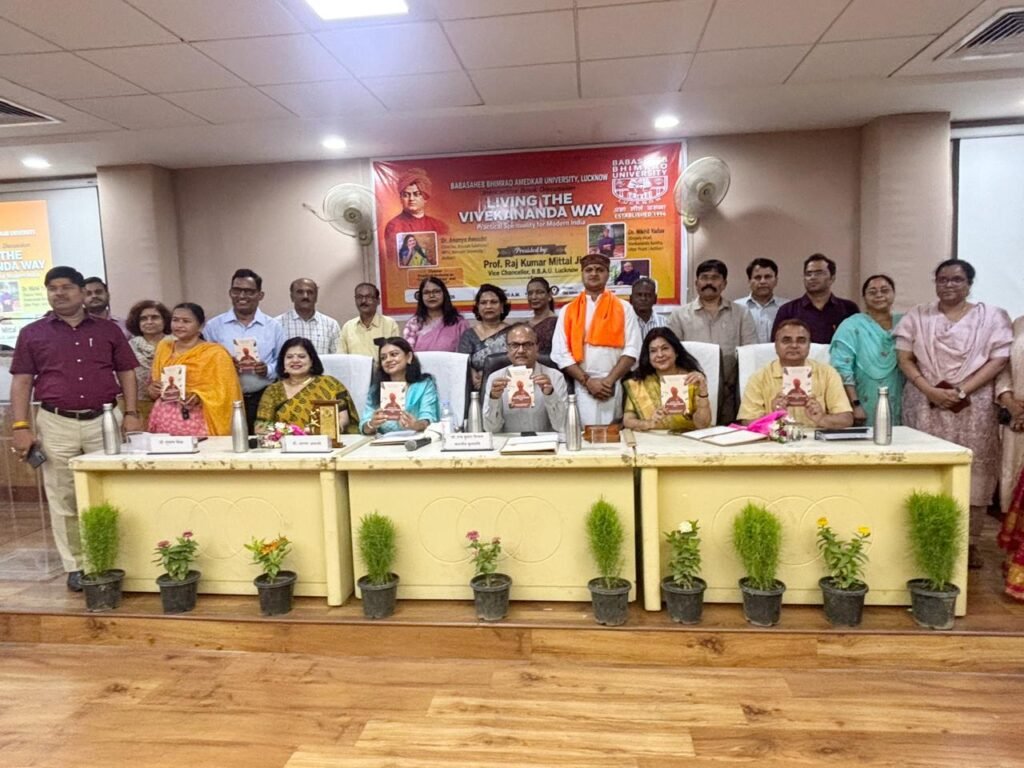
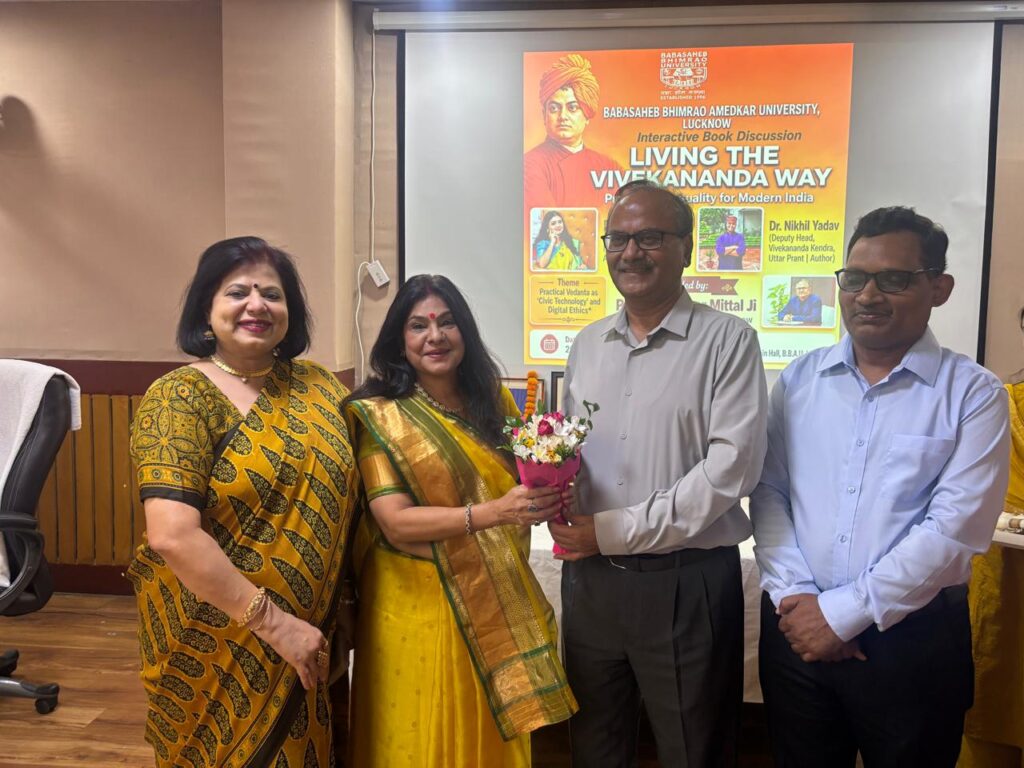
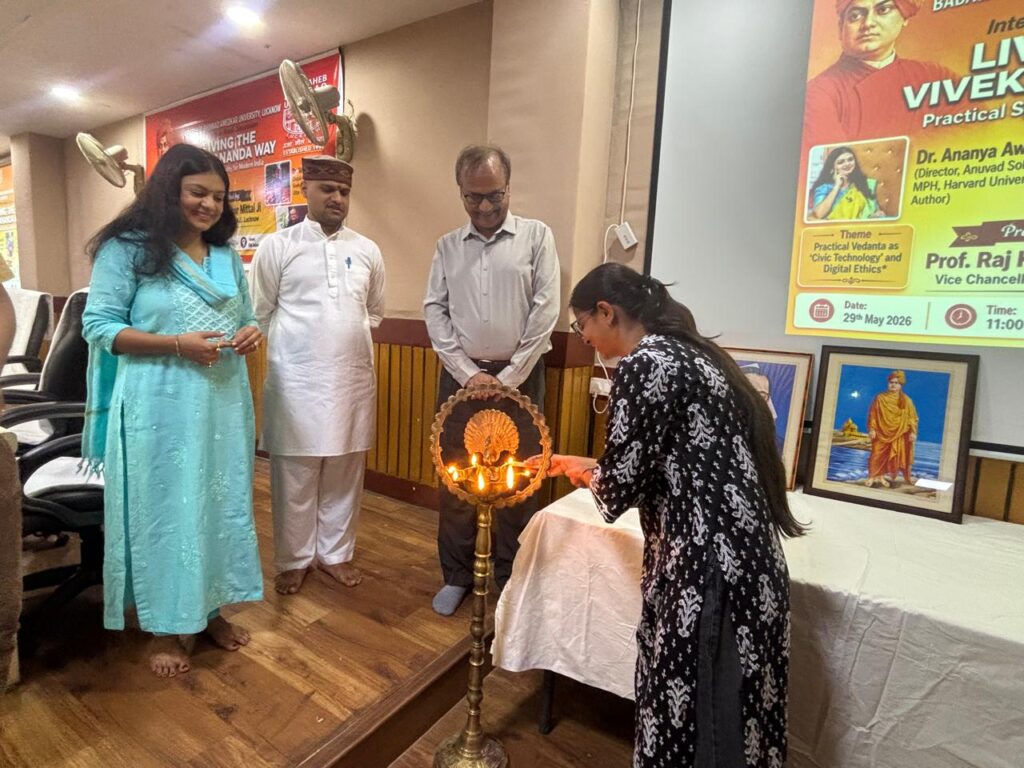
An interactive discussion session on the book “Living the Vivekananda Way: Practical Spirituality for Modern India” was organized on May 29 at Babasaheb Bhimrao Ambedkar University. The program was chaired by the Hon’ble Vice-Chancellor of the University, Prof. Raj Kumar Mittal. The book has been co-authored by Dr. Ananya Awasthi, Director of Anuvad Solutions, and Dr. Nikhil Yadav, Deputy Head of Vivekananda Kendra, Uttar Prant, who attended the event as distinguished guests. Apart from this, Renowned folk singer and social worker Mrs. Malini Awasthi, In-charge Head of the Department of Education Dr. Harishankar Singh, and Program Coordinator Dr. Subhash Mishra were also present on the dais. The program commenced with the ceremonial lighting of the lamp and floral tribute to the portrait of Babasaheb Dr. B. R. Ambedkar. Following the University Kulgeet, the organizing committee expressed gratitude to the guests by presenting bouquets, mementos, and shawls. At the beginning, Program Coordinator Dr. Subhash Mishra welcomed all the participants and introduced the objectives and outline of the event.
Vice-Chancellor Prof. Raj Kumar Mittal appreciated the efforts of the young authors and emphasized that the younger generation must deeply understand the life, ideas, and struggles of great personalities like Swami Vivekananda and Dr. B. R. Ambedkar. He remarked that there was a time when India was referred to merely as a “land of snake charmers,” but visionaries like Swami Vivekananda transformed the global perception of India through their wisdom, ideas, and spiritual consciousness. Prof. Mittal stated that today the entire world looks towards India with hope and trust because of its yoga, Indian knowledge traditions, scientific outlook, cultural heritage, spiritual wisdom, and the philosophy of “Vasudhaiva Kutumbakam,” all of which are establishing a strong global identity. He further noted that achieving the vision of a “Developed India” requires not only economic growth but also efforts towards social harmony, moral values, political awareness, education, research, and human sensitivity. He urged the youth to imbibe the ideals of Swami Vivekananda such as self-confidence, national service, discipline, character building, and positive thinking in their lives. He added that youth are the greatest strength of India, and when they channel their knowledge, energy, and values towards nation-building, India will move more powerfully towards becoming a global leader.
In her inaugural address, Dr. Ananya Awasthi highlighted the major challenges confronting the modern world. She said that humanity today is facing geopolitical conflicts, environmental crises, social inequalities, ethical dilemmas arising from the misuse of Artificial Intelligence and emerging technologies, as well as growing mental and emotional stress among youth. At such a time, she stated, the Vedanta-based spiritual philosophy presented by Swami Vivekananda has the potential to provide direction to the entire world. She explained that the essence of Indian philosophy lies in “oneness,” “harmony,” and “interconnectedness,” which teaches that all humanity is linked through one universal consciousness. Dr. Awasthi also elaborated on the relevance of Advaita Vedanta and the “Theory of Limited Existence,” explaining that human beings remain trapped in fear, conflict, jealousy, and isolation because they perceive themselves as limited beings, whereas Vedanta teaches that every individual is an inseparable part of the supreme consciousness. She said that when Vedanta is practiced in life rather than treated merely as theoretical knowledge, one realizes that all existence is a manifestation of the same source. She urged the youth to adopt Indian spiritual traditions, self-reflection, and moral values in their lives to contribute towards building a sensitive, balanced, and inclusive society.
Dr. Nikhil Yadav, Deputy Head of Vivekananda Kendra, Uttar Prant, stated that India is progressing continuously in fields such as science, technology, education, economy, culture, and global leadership, and that the country has undertaken a long and inspiring journey since independence. He said that the next twenty years would be crucial for India’s future and that the “Vivekananda Path” is the most inspiring and effective way to build a united, empowered, and developed nation. Referring to the teachings of Swami Vivekananda, he said that anyone wishing to truly understand India must first read Swami Vivekananda, as his vision presents a vibrant, spiritual, and extraordinary picture of the nation. Highlighting the uniqueness of Indian culture, Dr. Yadav said that Indian tradition has always regarded not only parents but also the poor and marginalized as divine, and this remains one of the greatest strengths of Indian civilization. He added that Swami Vivekananda envisioned a society where people could live peaceful, dignified, and meaningful lives. According to him, the nation can become strong only when its youth are mentally, morally, and socially empowered. Encouraging the youth to move ahead with positive thinking, discipline, and self-confidence, he remarked, “As you speak, so you think; as you think, so you act; and ultimately, so you become.” He therefore urged everyone to remain conscious of their thoughts, words, and actions and to contribute positively towards nation-building, social harmony, and human service by following the ideals of Swami Vivekananda.


During the program, an engaging interactive session was conducted in which students and research scholars asked various questions to the authors. Through this discussion, participants gained valuable insights into practical spirituality, youth empowerment, social transformation, and the relevance of Swami Vivekananda’s ideas in modern India.
At the end of the program, Dr. Subhash Mishra delivered the vote of thanks. Among those present during the event were Prof. Sunita Mishra, Dean of Academic Affairs Prof. S. Victor Babu, IQAC Director Prof. Shilpi Verma, Proctor Prof. Ram Chandra, Prof. K. L. Mahawar, along with other faculty members, non-teaching staff, research scholars, and students.
 ----------------------------------------------------------------------------------------------