
Jaishankar briefs Rajya Sabha on West Asia situation; safety of Indians top priority
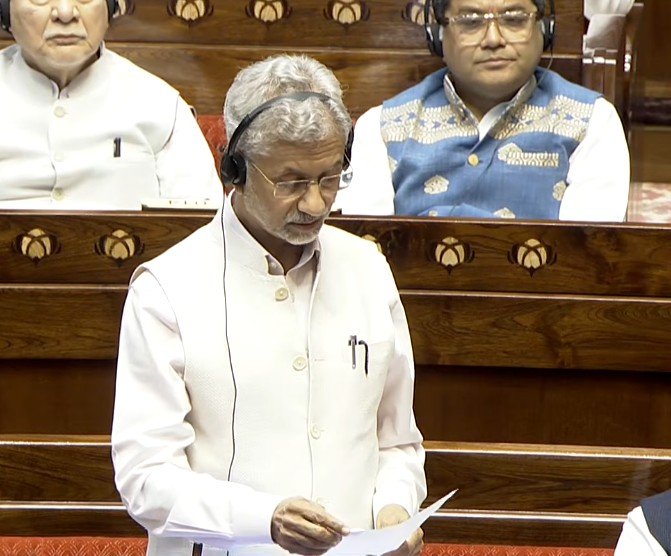
External Affairs Minister Dr. S. Jaishankar on Monday delivered a suo motu statement in the Rajya Sabha on the evolving situation in West Asia, describing the ongoing conflict as a matter of deep concern and outlining the government’s response to protect Indian nationals and safeguard national interests.
Addressing the House, the minister said the current round of conflict began on February 28, involving fighting between Israel and the United States on one side and Iran on the other, along with attacks affecting several Gulf states. The conflict has resulted in casualties, including among Iran’s leadership, and extensive damage to infrastructure across the region.

He said India had issued a statement on the very first day of the conflict expressing concern and urging restraint.
“We believed and continue to believe that dialogue and diplomacy should be pursued to de-escalate tensions and address underlying issues,” Jaishankar said, adding that the sovereignty and territorial integrity of all states must be respected.
Dialogue and diplomacy essential amid worsening crisis
Jaishankar said the Cabinet Committee on Security (CCS) met on March 1 under the chairmanship of Prime Minister Narendra Modi to review the situation following airstrikes in Iran and attacks across parts of the Gulf region.
The committee examined the implications of the conflict for regional stability, economic activity and the safety of the Indian community, and directed ministries to take necessary steps to address emerging challenges.
He noted that the conflict has continued to intensify, spreading to additional countries and affecting normal life and economic activity in parts of the region.
“We reiterated our call on March 3 for dialogue and diplomacy and spoke up for an early end to the conflict,” the minister told the House, expressing sorrow over the loss of lives.
Safety of Indians top priority; PM closely monitoring developments
Jaishankar said the developments in West Asia are of particular concern for India, given the large Indian diaspora and the region’s strategic importance.
“There are almost one crore Indian citizens who live and work in the Gulf nations,” he said, adding that several thousand Indians are also present in Iran for study and employment.
He said the government had been monitoring the situation closely since tensions escalated following the 12-day war in June 2025, issuing advisories well before the latest conflict began.
The Ministry of External Affairs advised Indian nationals to avoid non-essential travel to Iran on January 5, followed by stronger advisories on January 14 and February 14, urging Indians to leave the country through available transport options.
After the conflict began, the Indian Embassy in Tehran assisted several Indian students in relocating from Tehran to safer locations. Pilgrims and business travellers were also helped to move internally or cross into neighbouring countries such as Armenia to return home.
Jaishankar said Indian embassies across the region have issued advisories and set up helplines. The MEA has also established a special control room to assist affected individuals and their families.
He added that diplomats have been helping stranded passengers in major transit hubs such as Dubai, Doha and Abu Dhabi and facilitating cross-border travel where possible.
“Almost 67,000 Indian nationals have returned home so far,” he said, citing data from the Ministry of Civil Aviation that showed 51 inbound flights on March 7, 49 on March 8, and 50 planned for March 9.

Energy security and supply chains under watch
The External Affairs Minister said the conflict could also have implications for energy security, trade flows and supply chains, given the region’s importance to India.
The Gulf accounts for nearly 200 billion dollars in annual trade with India and remains a key source of oil and gas supplies.
He also noted attacks on merchant shipping in the region, where Indian nationals often form a significant portion of the crew. Two Indian mariners have lost their lives in such incidents, while one remains missing.
Warning of potential disruptions, Jaishankar said instability in the region could lead to serious supply chain challenges.
At the same time, he assured Parliament that the government is closely monitoring developments in energy markets.
“For us, the interests of the Indian consumer have always been and will remain the overriding priority,” he said.
India engages regional leaders amid crisis
Jaishankar informed the House that Prime Minister Narendra Modi has spoken with several regional leaders, including the President of the UAE, the Amir of Qatar, the Crown Prince of Saudi Arabia, the Crown Prince of Kuwait, the King of Bahrain, the Sultan of Oman, the King of Jordan and the Prime Minister of Israel.
These leaders assured India that the well-being of the Indian community would remain a priority.
Jaishankar added that he has also maintained contact with his counterparts in several countries and has spoken with Iran’s Foreign Minister on February 28 and March 5.
India reiterates three guiding principles
Concluding his statement, the External Affairs Minister outlined three guiding principles shaping India’s approach to the crisis.
First, India supports peace, restraint and a return to dialogue and diplomacy.
Second, the safety and welfare of the Indian community in the region remain the government’s foremost priority.
Third, India’s national interests, including energy security and trade flows, will remain paramount.
“I am confident that the government has the full support of this House on this matter,” Jaishankar said.