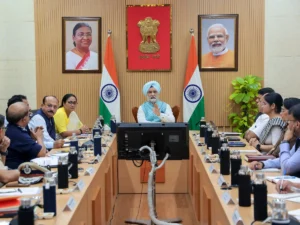

Cabinet-approved mobile phone manufacturing scheme to drive India’s electronics manufacturing
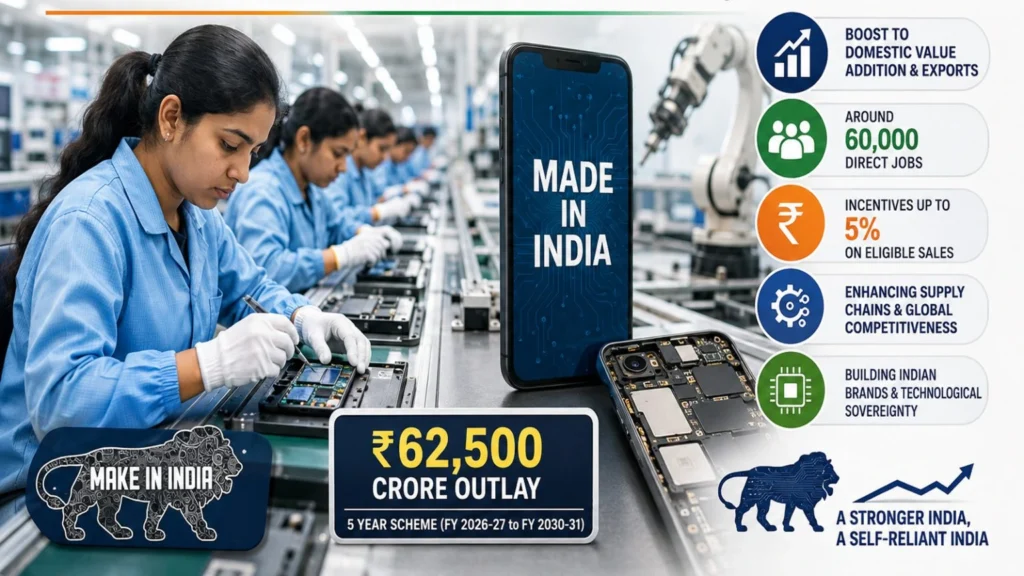
The Union Cabinet on Wednesday approved a new Mobile Phone Manufacturing Scheme (MPMS) with a budgetary outlay of ₹62,500 crore, aiming to deepen domestic value addition, strengthen supply chains, boost exports and consolidate India’s position as a global electronics manufacturing hub.
Chaired by Prime Minister Narendra Modi, the Cabinet’s decision builds on the rapid transformation of India’s electronics manufacturing sector over the past decade, during which the country has emerged as the world’s second-largest mobile phone manufacturer by volume and a major global export destination for smartphones.
Cabinet approves ₹62,500 crore MPMS
The five-year scheme, which will run from FY 2026-27 to FY 2030-31, provides incentive support ranging from 2.25 per cent to 5 per cent on eligible sales of mobile phones manufactured in India. Manufacturers will also receive an additional incentive of up to 1.5 per cent for increased domestic sourcing of key components and sub-assemblies. To encourage indigenous innovation, the scheme offers an additional 3 per cent incentive on eligible sales for companies investing in product design, research and development, and the creation of Indian brands.
According to the Ministry of Electronics & IT (MeitY), the scheme is expected to generate cumulative mobile phone production worth around ₹39 lakh crore during its tenure, significantly increase exports and create approximately 60,000 direct jobs.
The new initiative follows the successful conclusion of the Production Linked Incentive (PLI) Scheme for Large Scale Electronics Manufacturing, which ended on March 31, 2026. The PLI scheme played a transformative role in establishing India as a preferred destination for mobile phone manufacturing by attracting cumulative investments of more than ₹20,600 crore, generating production exceeding ₹11.62 lakh crore and exports of over ₹6.53 lakh crore.
MeitY said the MPMS has been designed to build on these gains by further scaling up manufacturing, enhancing global competitiveness, strengthening resilient supply chains and increasing domestic value addition while promoting technological sovereignty through the development of Indian brands and intellectual property.
Electronics manufacturing records rapid growth
India’s electronics manufacturing sector has witnessed remarkable growth over the last decade under the Make in India and Atmanirbhar Bharat initiatives. Electronics production has increased nearly seven-fold from ₹1.90 lakh crore in 2014-15 to an estimated ₹13.11 lakh crore in 2025-26. During the same period, electronics exports have grown more than eleven-fold, rising from ₹38,263 crore to ₹4.24 lakh crore, with electronic goods now emerging as India’s third-largest export category, valued at USD 47.96 billion in FY 2025-26.
Mobile phones emerge as India’s biggest export success
Mobile phone manufacturing has been the biggest driver of this transformation. Production has increased from ₹18,900 crore in 2014-15 to ₹6.27 lakh crore in 2025-26, registering a 33-fold rise. Mobile phone exports have surged from ₹1,566 crore to ₹2.60 lakh crore during the same period, recording a 165-fold increase.
The sector has also achieved a significant milestone, with smartphones becoming India’s largest exported product category in FY 2025-26, overtaking traditional export leaders such as diesel fuel and cut diamonds. Today, 99.2 per cent of mobile phones used in India are manufactured domestically, reflecting the country’s growing manufacturing capabilities and reduced import dependence.
Sector emerges as a major employment generator
The rapid expansion of the sector has also translated into large-scale employment generation. The electronics manufacturing industry has created nearly 25 lakh jobs over the past decade, while the mobile manufacturing ecosystem alone supports around 12 lakh direct and indirect jobs across the value chain.
Government initiatives implemented by MeitY have generated more than 5.3 lakh jobs, including around 1.8 lakh under the PLI scheme and another 3.5 lakh through other flagship programmes.
The sector has emerged as one of India’s largest industrial employers, with major manufacturing clusters in Hosur and Sriperumbudur in Tamil Nadu and Bengaluru in Karnataka together providing quality employment to more than one lakh people. Large electronics manufacturing facilities across the country employ tens of thousands of workers, reflecting the rapid expansion of India’s electronics ecosystem.
Women drive India’s electronics manufacturing workforce
Women’s participation has become one of the defining features of this growth story. Women account for nearly 30 per cent of the workforce created in electronics manufacturing over the last decade and constitute around 70 per cent of the direct workforce in mobile phone manufacturing, making it one of the country’s most women-intensive manufacturing sectors.
The PLI scheme alone created employment opportunities for around 90,000 women, while several leading electronics manufacturers report women forming the majority of their workforce. One of the country’s largest electronics manufacturers employs nearly 80,000 people across three major facilities, with women accounting for around 65 per cent of its workforce.
Stronger supply chains to power Viksit Bharat
The Ministry noted that India’s manufacturing ecosystem has also become deeper and more resilient. More than 40 major component manufacturers have established or expanded operations in the country, supported by an expanding network of Tier-2, Tier-3 and Tier-4 suppliers. Domestic value addition in electronics manufacturing has increased from 15 per cent to 23 per cent, reflecting greater localisation and stronger domestic supply chains.
MeitY said MPMS is expected to accelerate this momentum by strengthening domestic manufacturing capabilities, promoting innovation and research, enhancing exports and generating employment while positioning India as a trusted global manufacturing and technology partner.
With the launch of MPMS, the government aims to further reinforce the electronics sector as a key pillar of India’s industrial transformation and its vision of becoming a Viksit Bharat, driven by innovation, manufacturing excellence and inclusive economic growth.
 ----------------------------------------------------------------------------------------------