
Heroes of Kargil War: The Bravehearts whose courage defined Operation Vijay
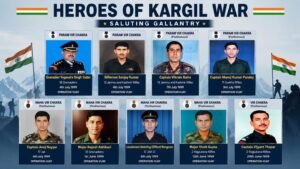
The victory in the 1999 Kargil War was forged through extraordinary courage, unwavering determination and the supreme sacrifice of India’s Armed Forces. Every peak recaptured during Operation Vijay bore testimony to acts of exceptional gallantry, as soldiers battled enemy positions on some of the world’s most inhospitable mountain terrain.
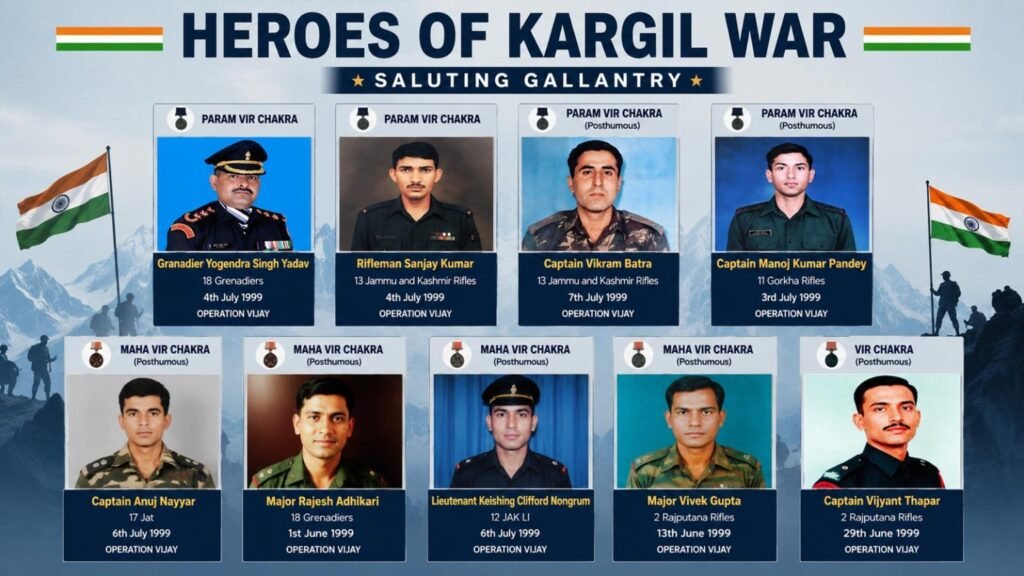
The nation recognised this unparalleled bravery with its highest military honours. During the conflict, four soldiers were awarded the Param Vir Chakra (PVC), India’s highest gallantry award. Nine soldiers received the Maha Vir Chakra (MVC), while 55 were honoured with the Vir Chakra (VC). One soldier was awarded the Sarvottam Yudh Seva Medal (SYSM), six received the Uttam Yudh Seva Medal (UYSM) and eight were conferred the Yudh Seva Medal (YSM). The Sena Medal was awarded to 83 personnel, while 24 received the Vayu Sena Medal, reflecting the extraordinary courage and dedication displayed throughout the conflict.

Grenadier Yogendra Singh Yadav: Scaling Tiger Hill Against All Odds
Among the most remarkable stories of Kargil is that of Grenadier Yogendra Singh Yadav of 18 Grenadiers, who played a pivotal role in the capture of Tiger Hill.

On July 3, 1999, under intense enemy shelling, he was part of the assault team tasked with scaling an icy cliff to reach the heavily fortified peak. Despite being struck by bullets in his shoulder and abdomen, he continued climbing and destroyed the first enemy bunker, enabling his platoon to advance. Refusing to retreat despite his injuries, he went on to eliminate another bunker and killed three enemy soldiers, inspiring his comrades to press ahead and secure Tiger Hill.
For his extraordinary courage in the face of overwhelming odds, he was awarded the Param Vir Chakra.
Rifleman Sanjay Kumar: Turning the Enemy’s Weapon Against Them
Another recipient of the Param Vir Chakra, Rifleman Sanjay Kumar of 13 Jammu and Kashmir Rifles, displayed exceptional bravery during the assault on a strategic feature in Mushkoh Valley on July 4, 1999.
Serving as one of the leading scouts, he came under intense machine-gun fire from an enemy bunker after reaching the summit. Undeterred, he engaged the enemy in close combat and killed three intruders despite sustaining serious injuries. As the remaining enemy soldiers fled, they abandoned a machine gun, which Kumar seized and turned against them, killing several more and helping his unit capture the objective.
His fearless determination earned him India’s highest gallantry award.
Captain Vikram Batra: The Hero Behind “Yeh Dil Maange More”
Few names are as closely associated with the Kargil War as Captain Vikram Batra of 13 Jammu and Kashmir Rifles.
He first led his troops to victory during the capture of Point 5140, personally eliminating four enemy soldiers in hand-to-hand combat. Following the successful operation, his radio message- “Yeh Dil Maange More” – became an enduring symbol of the fighting spirit displayed during the war.
Days later, on July 7, 1999, Captain Batra once again led from the front during the assault on Point 4875. Despite being seriously wounded in fierce fighting after killing five enemy soldiers, he continued to command his men until the objective was secured. He made the supreme sacrifice in battle and was posthumously awarded the Param Vir Chakra.
Captain Manoj Kumar Pandey: Leading Until His Final Breath
Captain Manoj Kumar Pandey of 11 Gorkha Rifles displayed extraordinary courage during the assault on Khalubar Ridge in the Batalik sector on July 3, 1999.
Facing heavy enemy fire, he led his company’s advance, destroying two enemy bunkers and killing four soldiers. Even after suffering injuries to his shoulder and legs, he continued pressing the attack, eliminating additional enemy positions before sustaining fatal injuries while leading his men to victory.
For his supreme sacrifice and exceptional bravery, he was posthumously awarded the Param Vir Chakra.
Captain Anuj Nayyar: A Leader Who Cleared the Way
The courage of Captain Anuj Nayyar of 17 Jat Regiment became one of the defining stories of the battle for the Tololing complex.
On July 6, 1999, during the assault on Pimple II, his company was pinned down by heavy enemy fire. Taking the initiative, Nayyar led from the front, personally destroying three enemy bunkers through grenade attacks and close combat. As he moved to eliminate a fourth bunker, he was fatally struck by a rocket-propelled grenade.

His actions broke the enemy’s defensive line and enabled his company to capture the objective. He was posthumously awarded the Maha Vir Chakra.
Major Rajesh Adhikari: Inspiring Victory Through Sacrifice
During the assault on Tololing on June 1, 1999, Major Rajesh Adhikari of 18 Grenadiers demonstrated exceptional leadership under relentless artillery and small-arms fire.
In a daring manoeuvre, he advanced across open ground to divert enemy fire away from his men and successfully neutralised a key bunker before being fatally hit. His sacrifice inspired his troops to continue the assault and ultimately capture the position.
He was posthumously honoured with the Maha Vir Chakra.
Lieutenant Keishing Clifford Nongrum: A Young Officer’s Extraordinary Resolve
At just 24 years old, Lieutenant Keishing Clifford Nongrum of 12 Jammu and Kashmir Light Infantry displayed remarkable courage during the assault on Point 4812 in the Batalik sector.
Leading his men up near-vertical slopes under heavy enemy fire, he repeatedly charged forward, accurately throwing grenades to silence enemy bunkers. Even after being wounded, he refused evacuation and continued leading the attack until he was fatally shot.
His determination inspired his troops to capture the objective, and he was posthumously awarded the Maha Vir Chakra.
Major Vivek Gupta: Leadership That Changed the Battle
The successful capture of Tololing owed much to the leadership of Major Vivek Gupta of 2 Rajputana Rifles.
On June 13, 1999, despite suffering injuries during a difficult night assault, he continued advancing and neutralised a critical enemy position that had stalled his company’s progress. Although he was later fatally wounded, his actions created the breakthrough that enabled Indian troops to seize the strategically important peak.
He was posthumously awarded the Maha Vir Chakra.
Captain Vijyant Thapar: Courage Beyond the Battlefield
At just 22 years of age, Captain Vijyant Thapar of 2 Rajputana Rifles became one of the youngest heroes of the Kargil War.
During the assault on Knoll in the Dras sector, he led his troops under relentless enemy fire, motivating them while eliminating multiple enemy bunkers in close combat. Despite being wounded, he continued the advance before being struck by a sniper’s bullet only metres from the objective. His actions contributed significantly to the success of the mission, earning him the Vir Chakra (Posthumous).
Captain Thapar’s legacy extends beyond the battlefield through the poignant letter he wrote to his family before the operation. In it, he expressed complete acceptance of his duty and urged his loved ones to live with pride, writing that he had no regrets. His words have since become a lasting symbol of selfless service and devotion to the nation.
A Legacy That Endures
The stories of these brave soldiers represent only a fraction of the extraordinary courage displayed during the Kargil War. Every honour awarded during Operation Vijay reflects not only individual heroism but also the collective determination of India’s Armed Forces to defend the nation’s sovereignty under the most challenging circumstances.
More than twenty-seven years after the conflict, the legacy of these Bravehearts continues to inspire generations of Indians, reminding the nation that courage, sacrifice and an unwavering commitment to duty remain the highest ideals of military service.
 ----------------------------------------------------------------------------------------------