Rajnath Singh inaugurates Indian War Memorial in Seoul commemorating Korean War legacy
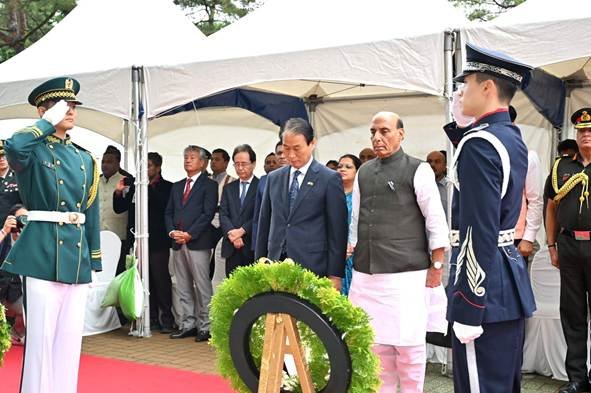
Defence Minister Rajnath Singh on Thursday inaugurated the Indian War Memorial at Imjingak Park in Seoul alongside South Korea’s Minister of Patriots and Veterans Affairs Kwon Oh-eul, commemorating the role Indian troops played during the Korean War and in its aftermath.
India and South Korea built the memorial as part of events marking the 75th anniversary of the Korean War. The memorial honours the Indian Army’s 60 Para Field Ambulance and the Custodian Force of India (CFI), which provided medical assistance, humanitarian support and post-war peacekeeping services during and after the 1950-53 conflict.

The two ministers laid wreaths at the memorial and paid tribute to Indian personnel whose contribution South Korea continues to remember with gratitude decades after the war.
Addressing the ceremony, Rajnath Singh said India’s contribution during the Korean War reflected the country’s longstanding commitment to peace, humanitarian assistance and international cooperation. He said the shared sacrifices and wartime history of India and South Korea continued to strengthen the Special Strategic Partnership between the two countries.

“Commemorating the role of Indian troops helps strengthen people-to-people understanding and brings renewed attention to the historic bonds between the two countries,” Singh said.
Singh also thanked the South Korean government, particularly the Ministry of Patriots and Veterans Affairs, for supporting the construction of the memorial.
Kwon Oh-eul praised India’s role during the war and said the service and sacrifices of Indian troops forged enduring bonds of friendship between Seoul and New Delhi.
The two ministers also signed an MoU aimed at cooperation in honouring Korean War veterans and strengthening exchanges between them. They later released a memoir dedicated to soldiers who served during the conflict.
Among India’s most significant contributions during the war was the work of the 60 Para Field Ambulance, commanded by Lt Col A.G. Rangaraj, Maha Vir Chakra. The unit treated thousands of wounded soldiers and civilians while operating under heavy crossfire and extremely difficult battlefield conditions.
South Korean civilians and soldiers later gave the unit the title “Maroon Angels” in recognition of its humanitarian and medical work.

India also played a major role after the signing of the Korean Armistice Agreement in 1953. Lt Gen K.S. Thimayya chaired the Neutral Nations Repatriation Commission (NNRC), while the Custodian Force of India supervised the custody and repatriation of prisoners of war.
Indian personnel handled the operation with professionalism, impartiality and compassion, earning international recognition for contributing to reconciliation and peace efforts on the Korean Peninsula.
Thimayya’s leadership and diplomatic role during the process continue to symbolise India’s constructive and peace-oriented approach during the Korean War.
The memorial stands at the same site where the Custodian Force of India established “Hind Nagar” in September 1954 to house nearly 22,000 prisoners of war before their peaceful repatriation.
India’s Ministry of Defence funded the memorial project, which officials described as an effort to preserve and honour a relatively lesser-known chapter of shared India-South Korea history.
Senior officials, diplomats, military representatives, veterans and distinguished guests from both countries attended the ceremony. Kalpana Prasad, niece of Lt Col Rangaraj, also attended the event. South Korea’s Ministry of Patriots and Veterans Affairs dedicated the month in honour of Rangaraj.
Rajnath Singh concluded his four-day visit to Vietnam and South Korea with the inauguration of the memorial.
 ----------------------------------------------------------------------------------------------