
India becomes World’s third-largest renewable energy capacity holder: Pralhad Joshi
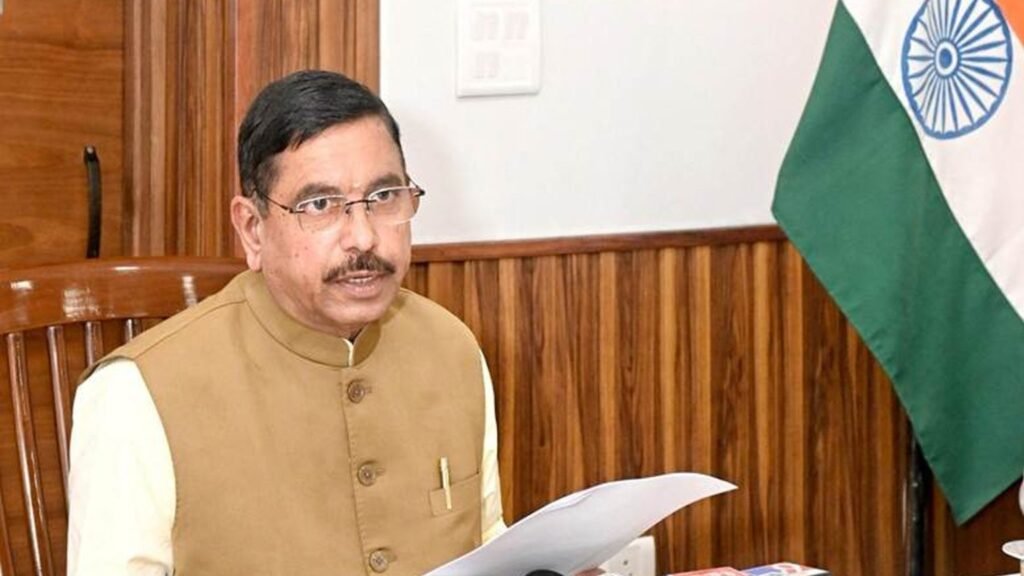
India has emerged as the world’s third-largest country in renewable energy installed capacity, overtaking Brazil, Union Minister Pralhad Joshi said on Wednesday.
Citing the latest Renewable Energy Statistics 2026 released by the International Renewable Energy Agency (IRENA), the minister said India now ranks behind only China and the United States in total renewable capacity.

Record Growth in Capacity and Generation
India achieved a total non-fossil fuel installed capacity of 283.46 GW as of March 31, 2026, including 274.68 GW from renewable sources and 8.78 GW from nuclear power.

During FY 2025-26, the country added a record 55.3 GW of non-fossil capacity – the highest annual increase to date – nearly doubling the previous year’s addition.
The country also reached a significant milestone in June 2025 by achieving 50% of its cumulative installed power capacity from non-fossil sources, five years ahead of its 2030 target under the Paris Agreement.
Renewables Power Over Half of Peak Demand
Highlighting a major achievement, Joshi said that in July 2025, renewable energy sources met 51.5% of India’s electricity demand of 203 GW – the highest-ever share.
Overall, renewable energy (including large hydro) contributed 26.2% of total electricity generation in FY 2025-26, while non-fossil sources accounted for 29.2%.
India’s total electricity generation during the year stood at 1,845.9 billion units (BU).
Solar and Wind Lead Expansion
Solar energy continues to dominate India’s renewable growth, with installed capacity surging to 150.26 GW – over 53 times higher than in 2014. Wind energy capacity also grew significantly to 56.09 GW.
FY 2025-26 saw the highest-ever annual solar capacity addition of 44.61 GW, driven by utility-scale projects, rooftop installations, and schemes such as PM KUSUM.
Distributed renewable energy, particularly rooftop solar, emerged as a major contributor, accounting for over one-third of total additions.
Wind energy also recorded a record annual addition of 6.05 GW, further strengthening India’s position as a global leader in wind power.
Manufacturing and Self-Reliance Boost
India has significantly expanded its renewable manufacturing base. Solar module manufacturing capacity has grown from 2.3 GW in 2014 to about 172 GW in 2026, while wind turbine manufacturing capacity has increased to around 24 GW.
Policy measures such as reduced GST on renewable energy equipment and incentives for domestic battery manufacturing have supported this growth, aligning with the government’s self-reliance goals.
Policy Push and Sector Reforms

The Ministry of New and Renewable Energy has introduced several policy initiatives during FY 2025-26, including:
* Reduction in GST on renewable equipment from 12% to 5%
* Launch of Renewable Energy Equipment Import Monitoring System (REEIMS)
* Introduction of Virtual Power Purchase Agreements (VPPA)
* Pilot scheme for Contracts for Difference (CfD)
* National Policy on Geothermal Energy
Regulatory reforms by the Central Electricity Regulatory Commission (CERC) have also improved grid access and transmission efficiency.
Green Hydrogen and Future Technologies
India is making rapid progress under the National Green Hydrogen Mission, with an outlay of ₹19,744 crore aimed at producing 5 million metric tonnes annually by 2030.
The initiative is expected to attract investments worth over ₹8 lakh crore, create more than 6 lakh jobs, and significantly reduce carbon emissions.
Major developments include record-low price discoveries for green ammonia and hydrogen, establishment of hydrogen hubs, and rollout of certification and safety standards.
Strengthening Infrastructure and Skill Development
The government has also invested in strengthening transmission networks through the Green Energy Corridor project and identified renewable energy zones with a potential of 345 GW.
On the workforce front, over 1.24 lakh individuals were trained in renewable energy sectors during FY 2025-26, supporting the industry’s rapid expansion.
Outlook
With a target of achieving 500 GW of non-fossil fuel capacity by 2030, India is on track to become a global leader in clean energy.
While challenges such as grid integration, storage, and supply chain dependencies remain, strong policy support, technological advancements, and rising investments are expected to sustain the country’s growth momentum in the renewable energy sector.
 ----------------------------------------------------------------------------------------------