

North Korea fires ballistic missiles as Pyongyang dismisses Seoul’s diplomacy hopes
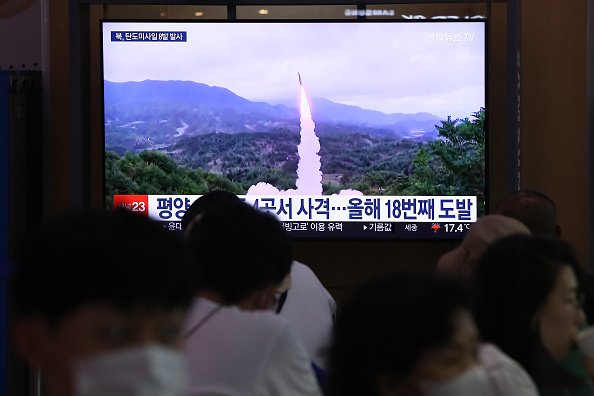
SEOUL, SOUTH KOREA - JUNE 05: People watch a television broadcast showing a file image of a North Korean missile launch at the Seoul Railway Station on June 05, 2022 in Seoul, South Korea. According to reports by the South Korean military, North Korea fired eight short-range ballistic missiles (SRBMs) toward the East Sea on Sunday, a day after South Korea and the United States wrapped up their joint drills near the peninsula. (Photo by Chung Sung-Jun/Getty Images)
North Korea fired several ballistic missiles toward the sea off its east coast on Wednesday, South Korea’s military said, following a separate launch detected a day earlier as Pyongyang doused Seoul’s hopes of an easing in tensions.
South Korea’s Joint Chiefs of Staff (JCS) said the unidentified short-range missiles were launched at around 8:50 a.m. (2350 GMT Tuesday) from near Wonsan on the North’s east coast.

The missiles flew 240 km (150 miles), the JCS said, adding that South Korean and U.S. authorities were conducting a detailed analysis of the launch. South Korea’s military also said it had detected the launch of a suspected ballistic missile from near Pyongyang on Tuesday.
South Korea’s presidential Blue House convened an emergency National Security Council meeting on Wednesday, calling the launches a provocation that violated U.N. Security Council resolutions, according to media reports.It urged Pyongyang to end such tests.
Japan’s Chief Cabinet Secretary Minoru Kihara said the missiles fired by North Korea this week did not enter the country’s territorial waters or exclusive economic zone and caused no damage.
Pyongyang’s actions “threaten peace and security in the region and the international community,” Kihara said, adding Tokyo would cooperate with Seoul and Washington to monitor the situation.
According to South Korea’s Yonhap news agency, citing military officials, the projectile launched on Tuesday was likely a ballistic missile that flew eastward before showing signs of an abnormality in the early stage of flight and disappearing.
The incidents mark North Korea’s fourth and fifth ballistic missile launches this year, following two launches in January and another in March.
South Korea typically announces North Korean ballistic missile launches promptly, as such tests violate U.N. Security Council resolutions against the North’s missile programme.
North Korea rejects the U.N. ban and says it infringes its sovereign right to self-defence.
HOSTILE ENEMY

The disclosure of the latest launches came after a combative statement by a top North Korean official that made clear that Pyongyang saw no shift in its hostile stance toward Seoul despite hopes of a thaw in relations.
Jang Kum Chol, a senior official at North Korea’s foreign ministry, said the South was engaging in wishful thinking if it thought Pyongyang was ready to see Seoul as anything other than an enemy.
“The identity of the ROK, the enemy state most hostile to the DPRK, can never change with any words or conduct,” Jang was quoted as saying by state media KCNA late on Tuesday, using the formal acronyms for the names of South and North Korea.
The comments contrasted with a statement from North Korea on Monday, which said South Korean President Lee Jae Myung was “very fortunate and wise” to convey regret to Pyongyang for drone incursions earlier this year.
Some in Seoul saw that statement as a rare act of conciliation from the nuclear-armed North after decades of hostility. The two nations remain technically at war after their 1950-1953 conflict ended in a truce.
But Jang said the statement issued by North Korean leader Kim Jong Un’s powerful sister, Kim Yo Jong, amounted to a warning to Seoul, and dismissed interpretations that it reflected friendly intentions.
Yang Moo-jin, a professor at the University of North Korean Studies in Seoul, said Pyongyang appeared intent on quickly shutting down what it saw as overly optimistic readings in the South, while continuing weapons testing to reinforce its deterrence.
“North Korea briefly acknowledged Seoul’s tension‑easing efforts, but moved within a day to block hopeful interpretations and re-assert its hostile-state framework,” Yang said.
Responding to Jang’s comments, the Blue House on Wednesday said insults and hostile rhetoric did “nothing to promote peace and stability” on the Korean peninsula, adding that Seoul would continue efforts toward peaceful coexistence, Yonhap reported.