
National Handicrafts Week Shines Light on India’s Rural Craft Economy
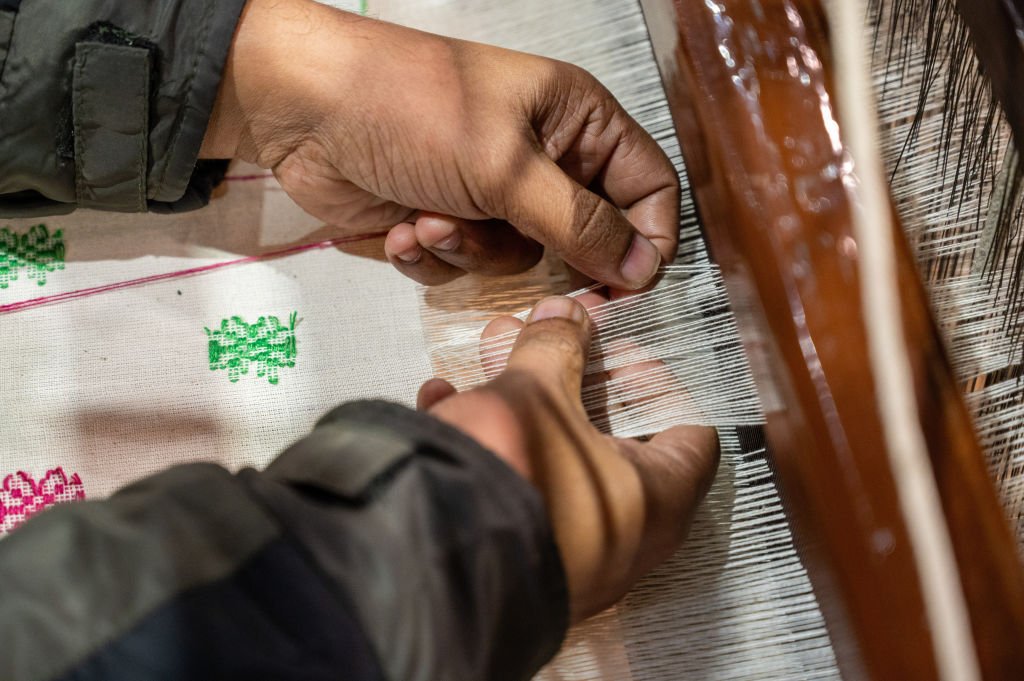
NEW DELHI, INDIA - 2024/01/08: An Indian handloom weaver from Nadia District showcases Jamdani weaving art on a traditional wooden hand-weaving loom during Aatmanirbhar Bharat Utsav 2024 at Pragati Maidan. The Aatmanirbhar Bharat Utsav aims to showcase and celebrate self-reliance in India. (Photo by Pradeep Gaur/SOPA Images/LightRocket via Getty Images)
The country is celebrating National Handicrafts Week from December 8 to14 with a renewed focus on rural artisans, traditional craftsmanship and the government schemes that support India’s vibrant craft economy.
The week also features the National Handicrafts Awards, including the Shilp Guru honours, recognising master craftspersons who protect and innovate India’s artistic heritage.

Rural Livelihoods and Women at the Core
India’s handicraft heritage today spans 318 GI-tagged products and 455 recognised craft categories, reflecting the diversity of skills rooted in villages and semi-urban clusters. The sector supports an estimated 64.66 lakh handloom and handicraft artisans, with major concentrations in Uttar Pradesh, Rajasthan, Assam, Odisha, West Bengal and Tamil Nadu.
Women continue to drive the craft economy, comprising 71% of handloom weavers and 64% of all artisans as of August 2025. Many artisans belong to SC, ST and OBC communities, making handicrafts a source of inclusive livelihood. For agrarian families, crafts provide crucial supplementary income during agricultural lean periods.
The government also highlighted progress in formalising the artisan workforce. Over 32 lakh artisans have been registered under the Pehchan ID Programme, including nearly 20 lakh women, giving them access to training, credit and welfare schemes.
Exports Remain Resilient Amid Global Challenges
Despite international market uncertainties, India’s handicraft exports have shown strong performance. Between April and September 2025, textiles and apparel exports including handicrafts reached US$18,235.44 million. In 2024-25, handicraft exports (excluding hand-knotted carpets) climbed to ₹33,122.79 crore, up from ₹20,082.53 crore in 2014-15.
Key export categories included woodware, art metal wares, embroidered and crocheted goods, hand-printed textiles and imitation jewellery. The United States remained the largest buyer, accounting for 37% of India’s handicraft shipments.

To sustain this growth, the government continues to expand support through the National Handicraft Development Programme (NHDP), which carries an outlay of ₹837 crore for 2022–26. In 2023–24, 2,325 projects were sanctioned, benefiting more than 66,000 artisans through design development, marketing assistance, infrastructure creation and social-security measures. Skill programmes ranging from design workshops to the Guru Shishya initiative and NSQF-based training are being used to prepare artisans for evolving market demands.
Cluster development has been strengthened under the Comprehensive Handicrafts Cluster Development Scheme (CHCDS) with an outlay of ₹142.5 crore, aimed at building world-class production hubs. Additionally, over 100 clusters have been supported under SFURTI to improve productivity and help artisans transition into entrepreneurial roles.
In FY 2023–24, 786 marketing events were organised under NHDP, with 132 more planned for 2025–26. Events such as Indie Haat 2025 and the handicrafts pavilion at IITF 2025 have given artisans vital access to domestic and international buyers.
Parallel support to the handloom sector continues, with 356 small and two mega clusters sanctioned in the past five years, 42,895 MUDRA loans, and 163 producer companies formed. More than 5.35 lakh beneficiaries have been trained under SAMARTH, with 4.20 lakh placements recorded.
Export schemes such as RoSCTL and RoDTEP are helping reduce hidden costs for exporters, while the new Export Promotion Mission aims to boost MSME participation. GST rate cuts on several handicraft items and the consolidation of 29 labour laws into four labour codes have also eased compliance and improved worker protections.
As National Handicrafts Week highlights the contributions of India’s artisans, the government said rising global demand for sustainable, handmade products and continued policy support position the sector for strong growth. With its deep cultural roots and expanding market linkages, India’s handicraft industry is expected to remain a key driver of rural livelihoods and economic progress.