
India’s rise from ‘fragile five’ to fourth-largest economy reflects shift in confidence and capability: Jitendra Singh
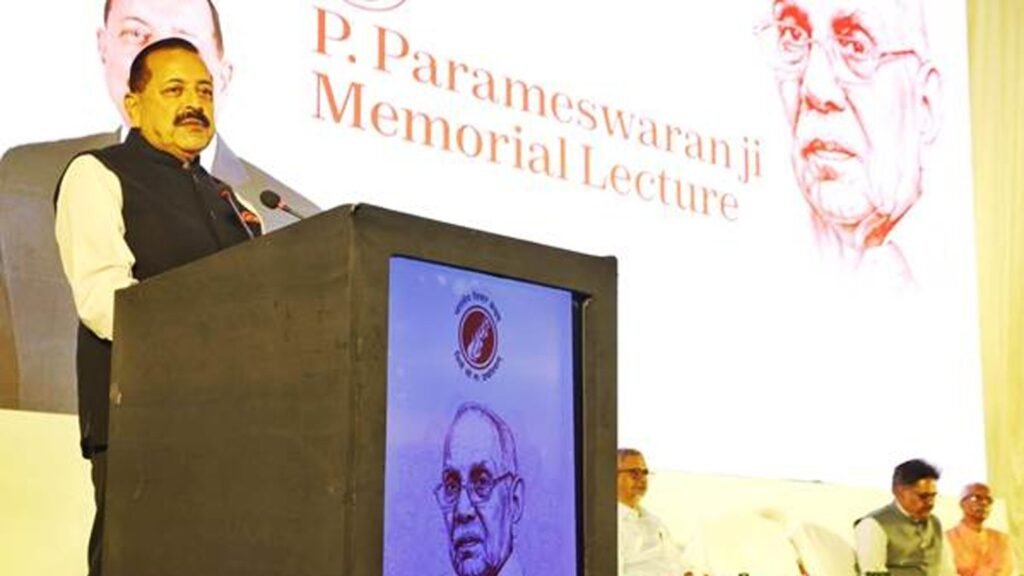
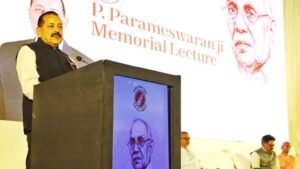
Union Minister of State (Independent Charge) for Science & Technology and other key portfolios, Jitendra Singh, on Saturday said India’s journey from being grouped among the “Fragile Five” economies in 2014 to emerging as the world’s fourth-largest economy marks a decisive shift in national confidence, capability and direction.
Delivering the P. Parameswaran Memorial Lecture on the theme “Viksit Bharat @2047: Science, Technology and Future Ready Innovation for National Transformation” at Kowdiar in Thiruvananthapuram, he said India is firmly on course to become the third-largest economy in the near future and achieve the goal of a developed nation by 2047.

The lecture, organised by Bharatheeya Vichara Kendram in memory of noted thinker and social leader P. Parameswaran, coincided with National Science Day.
Reflecting on India’s civilisational journey, Singh said the country has endured invasions, colonial rule and systemic exploitation, yet has emerged stronger with renewed self-belief. He added that democracy has deepened in recent years, empowering even the most underprivileged citizens to aspire without barriers.
“Democracy becomes meaningful when even a mother in the poorest household can dream that her child can become a scientist, doctor or civil servant, and believe that the system will allow that dream to be realised,” he said.
Highlighting India’s innovation landscape, the Minister said the country has climbed from 81st position in the Global Innovation Index in 2014 to 38th today. He noted that India now has over two lakh startups generating more than 21 lakh jobs. Recalling the launch of the Startup India initiative in 2015, he said the concept has grown into a nationwide movement, with nearly half of startups emerging from Tier-2 and Tier-3 cities and a significant share being women-led enterprises.
He observed that women scientists and innovators are increasingly leading national missions in space, science and governance, signalling a shift in the discourse on women’s empowerment.

On research output, Singh said India ranks sixth globally in patent filings, with more than 60 per cent filed by resident Indians. He added that India is among the top countries in scientific publications, with thousands of Indian researchers featuring among the top two per cent globally.
Referring to reforms in the space and nuclear sectors, he said policy changes have opened doors for private participation, significantly expanding India’s space economy. Indigenous defence and advanced technology capabilities have also grown, leading to rising exports and greater self-reliance.
Touching upon the Ocean Mission, he said India is uniquely positioned as the only country with an ocean named after it, and exploration of marine resources, deep-sea minerals and biodiversity will contribute substantially to future economic value addition.
The Minister also highlighted policy initiatives such as the National Education Policy 2020, Atal Innovation Mission, PM Mudra Yojana, PM Vishwakarma Yojana and PM SVANidhi. These measures, he said, are expanding opportunities beyond conventional government employment by encouraging entrepreneurship, supporting artisans and empowering street vendors.
Calling it “the best time to be in India,” Singh urged young Indians, including those studying abroad, to stay connected to the country’s growth story. While global exposure is valuable, he said, India today offers unprecedented opportunities in research, innovation and enterprise.
Concluding his address, he said the vision of Viksit Bharat in 2047 will be shaped by today’s youth. The responsibility of the present generation, he added, is to strengthen institutions and build an enabling ecosystem so that when India marks 100 years of Independence, it stands as a fully developed, innovation-driven and globally respected nation.