

India pushes industry-led water conservation and data-driven governance at World Water Day Conclave 2026
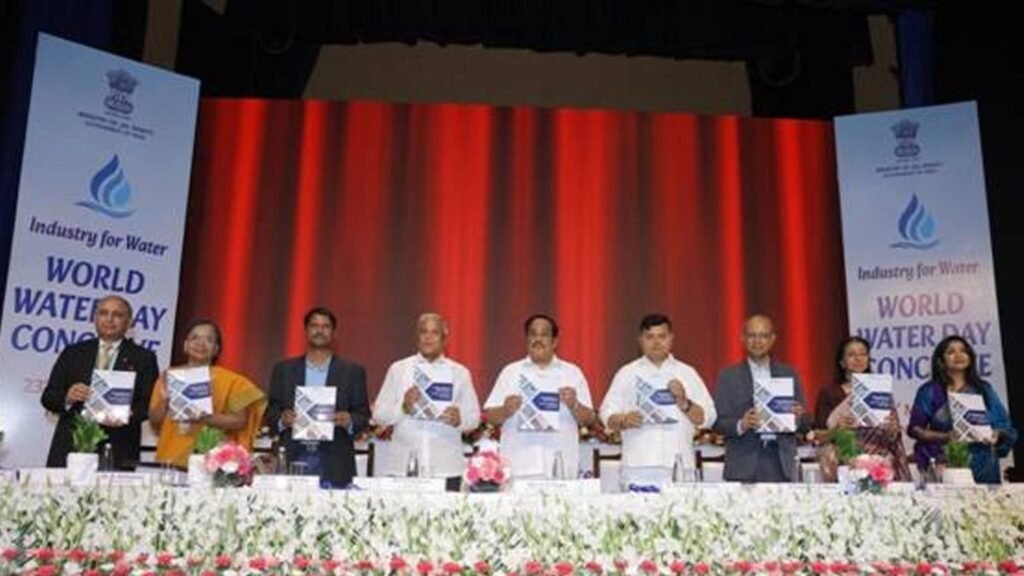
India reinforced its commitment to sustainable water management and conservation at the World Water Day Conclave 2026, with a strong emphasis on industry participation, innovation, and data-driven governance. Organised by the Jal Shakti Ministry at Dr. Ambedkar International Centre, the event brought together over 700 delegates, including policymakers, industry leaders, researchers, and stakeholders.
Union Jal Shakti Minister C. R. Paatil, who inaugurated the conclave, called for greater public participation in water conservation, stressing that “Jan Bhagidari se Jal Sanchay Sambhav hai.” He underlined that water conservation must be treated as a shared national responsibility, requiring coordinated efforts across government, industry, agriculture, and communities.

Held under the theme “Industry for Water,” the conclave highlighted the role of industries in improving water-use efficiency, promoting recycling and reuse, and moving towards a circular water economy. The minister reiterated the importance of conserving every drop, linking sustainable water practices to India’s long-term economic growth and climate resilience.
A major highlight of the event was the release of key national reports and policy documents, including the 7th Minor Irrigation Census, the 2nd Census of Water Bodies, the 1st Census of Springs, the Census of Major and Medium Irrigation Projects, and the National Water Data Policy 2026. These initiatives are expected to strengthen evidence-based policymaking and improve water governance across the country.
The conclave also recognised innovation in the sector, felicitating 19 winners of the Jal Shakti Hackathon for developing scalable solutions in water management. States such as Bihar, Andhra Pradesh, and Assam were acknowledged for successfully completing major water census exercises.

Industry participation featured prominently, with leading associations like FICCI, ASSOCHAM, and Confederation of Indian Industry committing to key goals such as conducting regular water audits by 2027, adopting real-time monitoring systems, achieving water neutrality, and reducing water footprints by 50% by 2030.
The event included multiple thematic sessions covering sludge management, industrial water efficiency, glacier monitoring, and the use of water census data. Discussions highlighted the need to treat sludge as a resource, adopt emerging technologies like AI and IoT, and strengthen scientific understanding of glaciers and water systems in the Himalayan region.
Participants also explored how water census data can be leveraged for better planning and implementation of schemes related to irrigation, water conservation, and rural development.
The conclave concluded with a strong consensus on adopting a whole-of-government and whole-of-society approach to water management. It emphasized enhanced collaboration, technological adoption, and policy integration as key drivers for achieving a water-secure and climate-resilient future for India.