
India is becoming key growth engine of global economy: PM Modi
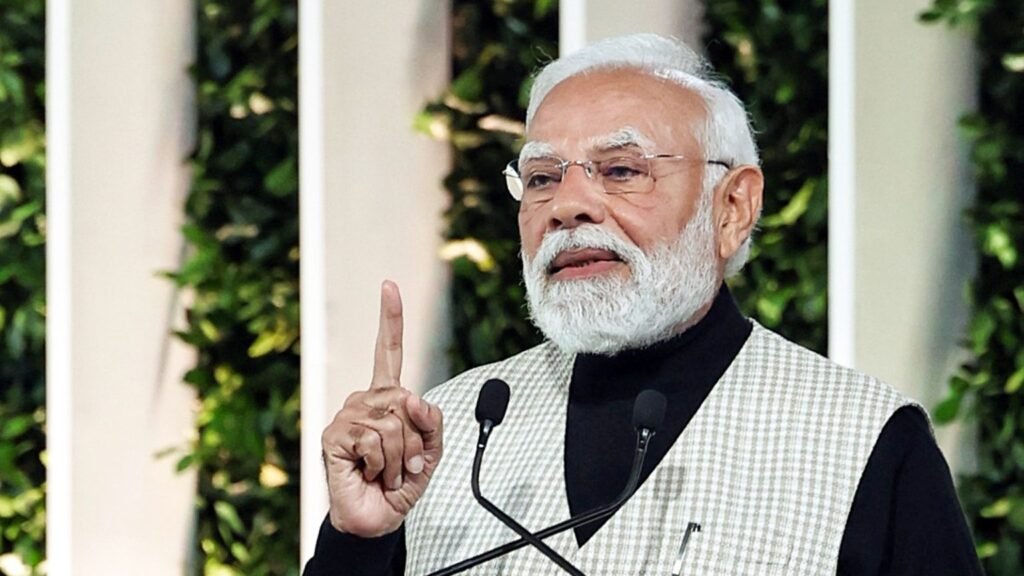
Prime Minister Narendra Modi on Saturday addressed the Hindustan Times Leadership Summit 2025 in New Delhi, asserting that India is emerging as a key growth engine for the global economy and is demonstrating confidence amid global uncertainty.
PM Modi noted the presence of prominent national and international delegates and acknowledged the contributions of the Hindustan Times team. He recalled suggestions he had made during a previous visit and expressed satisfaction that they were implemented, particularly praising a photography exhibition at the venue.

He pointed out that the Summit’s theme, Transforming Tomorrow, aligns with India’s current trajectory of social and economic change. PM Modi also paid tribute to Dr. B.R. Ambedkar on Mahaparinirvan Diwas.
Referring to India’s recent GDP numbers, PM Modi said the country’s over 8% growth in the second quarter reflects strong economic momentum at a time when global growth remains low. He noted that India has become a model of “high growth and low inflation,” contrasting this with earlier periods when economists expressed concerns about inflation.
PM Modi said India’s progress is driven by resilience and the ability to find solutions, adding that these attributes are shaping both the present and the future.
The Prime Minister said the government’s approach is centred on enabling regions and groups whose potential had remained underutilized for decades – such as eastern India, the Northeast, smaller cities, women, the youth, and the space sector.
He highlighted reforms in the space industry, referencing the recent opening of Skyroot’s new campus and the company’s progress in rocket development.
PM Modi said similar reforms are taking place across sectors and that 2025 has been a significant year for policy changes, including the next-generation GST framework and a new direct tax structure with zero tax on income up to ₹12 lakh. He also pointed to the revised definition of small companies, which will ease compliance for thousands of businesses.
A large part of PM Modi’s speech focused on freeing India from what he described as a “colonial mindset.” He argued that colonial rule weakened India’s self-confidence and affected multiple sectors, including manufacturing, governance, shipbuilding, and defence production.

PM Modi criticised the historical use of the term “Hindu rate of growth,” calling it an example of a mindset that unfairly projected Indian traditions and society as unproductive.
He noted that India’s defence and shipbuilding sectors, which were strong during and before the colonial era, were later neglected due to preference for foreign products. The Prime Minister said current efforts aim to revive these sectors and reduce dependence on imports.
PM Modi spoke about improving trust in governance, citing measures such as self-attestation of documents, decriminalisation of minor offences under the Jan-Vishwas law, and guarantee-free loans worth ₹37 lakh crore under the Mudra Yojana.
He also highlighted efforts to return unclaimed financial assets – ₹78,000 crore in banks and additional amounts with insurers, mutual fund companies, and dividends—through special district-level camps.
The Prime Minister said that missed opportunities in areas such as semiconductors have cost India valuable time, and therefore current policies are aimed at preventing a repeat.
He emphasised the rapid expansion of solar power capacity from 3 GW in 2014 to around 130 GW today. Citing Varanasi as an example, he noted that over 26,000 households have installed rooftop solar systems under the PM Surya Ghar Muft Bijli Yojana.
PM Modi also highlighted the shift in mobile phone manufacturing, with imports falling from 75% before 2014 to near-zero today.
PM Modi concluded by saying that India’s effort to “transform tomorrow” is not limited to government programmes but is a national commitment requiring cooperation from every section of society. He thanked the participants and the organisers of the Summit.