
India among few ancient civilisations to emerge as modern nation-state: EAM Jaishankar
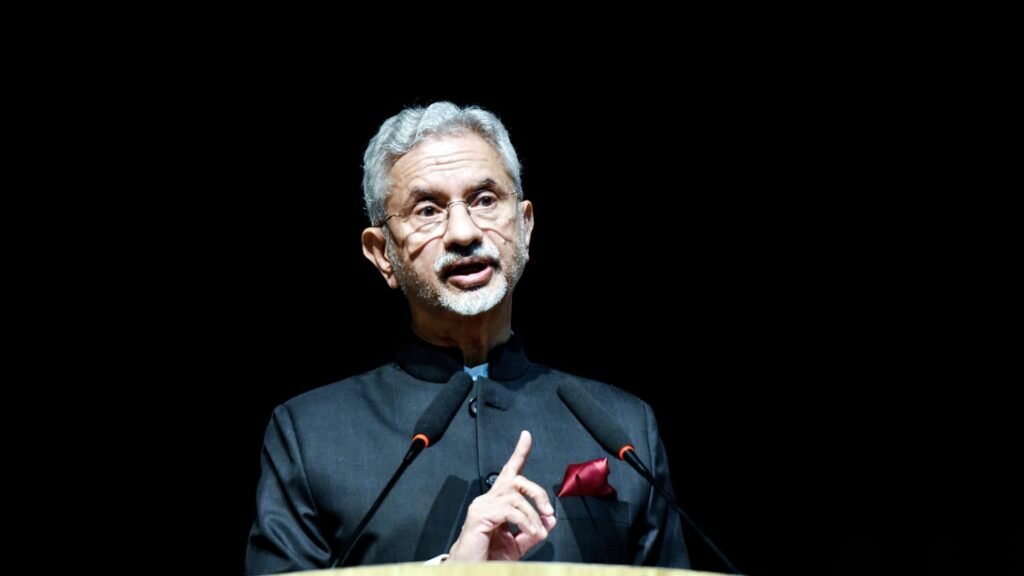
External Affairs Minister S. Jaishankar on Friday said India is among the very few ancient civilisations in the world that have survived, adapted and evolved into a major modern nation-state, giving the country a deep historical continuity that most nations do not possess.
Speaking at the launch of IIT Madras Global and the inaugural session of the institute’s annual technical festival Shaastra at IIT Madras, Jaishankar said India’s civilisational journey provides it with a unique global perspective.

He underlined that India’s choice of democracy has had far-reaching global consequences. Jaishankar said that by adopting a democratic political system, India helped make democracy a universal political idea, rather than a limited or regional concept.
The External Affairs Minister stressed that India has a responsibility to articulate its values, culture and history on the global stage, while doing so through cooperative and mutually beneficial partnerships, particularly with Western nations. He noted that such partnerships are critical to shaping the future global order.
Jaishankar observed that India today operates with relatively limited resources compared to earlier decades and must therefore focus on achieving maximum global impact. He said this is being done by leveraging India’s strengths, competitiveness, domestic institutions and international partnerships.
Citing IIT Madras’ overseas initiatives as an example, he said the establishment of an IIT Madras campus in Tanzania demonstrates how Indian foreign policy increasingly uses domestic institutions to create significant global impact.
Referring to the concept of Vasudhaiva Kutumbakam, Jaishankar said India has historically viewed the world not as a hostile environment but as a shared space where cooperative problem-solving is possible. He described India as a “human resource power,” noting that while some nations rely on natural resources, India’s strength lies in its people.

Highlighting India’s role during the Covid-19 pandemic, Jaishankar said the country emerged as one of the world’s most efficient producers of vaccines, reinforcing its global contribution during times of crisis.
During the event, IIT Madras announced several international collaborations as part of its global expansion. Three memorandums of understanding were signed with German institutions, including Technische Universität Dresden and Carl Zeiss, with IIT Madras set to host Carl Zeiss’ first hub outside Germany.
In Malaysia, IIT Madras partnered with the Advanced Semiconductor Academy to develop semiconductor talent, while agreements were signed with the Aisling Group. In Singapore, IIT Madras Global entered a market access partnership with GATES APAC to support Indian deep-tech startups in reaching ASEAN markets.
The institute also signed agreements in the UAE with the Dubai Department of Economy and Tourism to support research, academia and startup innovation aligned with Dubai’s D33 agenda, along with partnerships involving the World Government Summit and private sector entities.
Additional collaborations were announced with institutions in the United Kingdom and the United States, including Durham University and Rutgers University. With the support of the Ministry of External Affairs, IIT Madras has also become the first IIT to establish an overseas campus at Hensiberg.