
Indian steel sector maintains growth momentum in April; prices rebound across segments
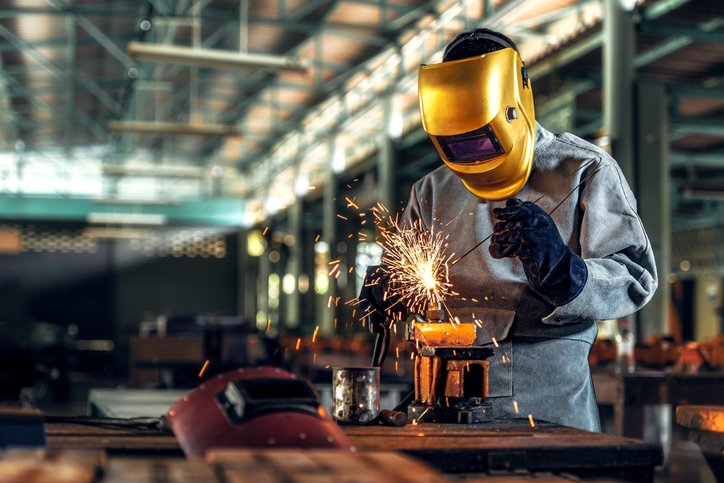
Worker welder working welding steel in industry with safety mask safety gloves and safety equipment. Worker welding concept.
India’s steel sector sustained its growth momentum in April 2026, posting year-on-year gains across key production and consumption indicators, reflecting steady domestic demand and stable industrial activity.
Crude steel production rose to 14.09 million tonnes in April, marking a 5.8 per cent increase from 13.31 million tonnes in the same month last year. Hot metal output grew 5.4 per cent year-on-year, while pig iron production declined by 6 per cent to 0.69 million tonnes. Finished steel production stood at 13.05 million tonnes, up 3.4 per cent annually.

Demand remained robust, with finished steel consumption reaching 12.99 million tonnes, registering an 8.1 per cent year-on-year growth, driven by sustained activity in construction, infrastructure, and manufacturing sectors.
On the trade front, India remained a marginal net importer during the month. Steel imports stood at 0.68 million tonnes, while exports were recorded at 0.47 million tonnes. Compared to April 2025, imports rose by 30.8 per cent and exports by 24.9 per cent.
India’s total steelmaking capacity reached around 220 million tonnes per annum (MTPA) in FY 2025–26, progressing towards the National Steel Policy target of 300 MTPA by 2030. Major steelmakers continued to invest in capacity expansion. Notably, Tata Steel commissioned a ₹3,200 crore scrap-based electric arc furnace (EAF) green steel plant with a capacity of 0.75 MTPA in Ludhiana, marking a first-of-its-kind facility in Punjab.

Under the Ministry of Steel’s Green Steel Initiative, the National Institute of Secondary Steel Technology (NISST) continued to drive certification efforts. As of March 31, 2026, green steel certificates had been issued to 90 producers across 15 states, covering products such as TMT bars, HR/CR coils, wire rods, and pipes. A majority of these products achieved the highest five-star rating, indicating growing industry adoption.
Steel prices showed a broad-based recovery in April. TMT or rebar prices increased by around 2.6 per cent month-on-month and 3 per cent year-on-year, marking the first positive annual growth after a prolonged period of softness. Flat steel products recorded sharper gains, with hot-rolled (HR) coil prices rising approximately 6.3 per cent and galvanised plain (GP) sheet prices up about 7.3 per cent over the previous month.
Raw material prices presented a mixed trend. Domestic iron ore prices strengthened significantly, with NMDC raising lump and fines prices by around 10–11 per cent month-on-month. Global seaborne iron ore prices remained largely stable. However, international coking coal prices continued to edge higher, keeping input cost pressures elevated for integrated producers. Scrap prices in the international market remained broadly flat, providing some stability for electric arc furnace-based producers.
The outlook for the sector remains positive, supported by continued government-led infrastructure spending and expanding manufacturing activity. However, challenges related to energy security, raw material price volatility, and global trade conditions are expected to remain key concerns in the coming months.
 ----------------------------------------------------------------------------------------------