
India ‘riding the Reform Express’: PM Modi
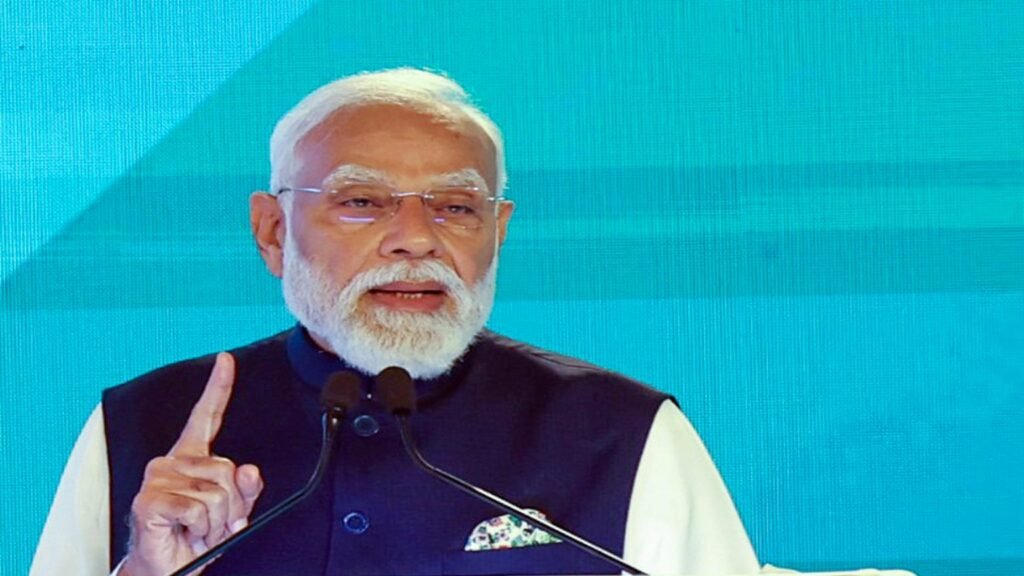
Prime Minister Narendra Modi on Friday said India is “riding the Reform Express” and emerging as a key driver of global growth, as he addressed the ET Now Global Business Summit 2026 in New Delhi.
Speaking on the theme “A Decade of Disruption, A Century of Change”, the Prime Minister said that despite global shocks over the past decade – including the pandemic, geopolitical tensions and supply chain disruptions – India has recorded “unprecedented development”, strong policy delivery and a strengthening of democratic institutions.

Recalling that India was the 11th largest economy a decade ago, PM Modi said the country is now rapidly moving toward becoming the world’s third-largest economy. He noted that India currently contributes over 16 per cent to global growth and expressed confidence that this share will continue to increase, positioning India as a new engine of the world economy.
The Prime Minister said the post-World War II global order, built on a “one size fits all” approach, is now weakening as countries focus on building resilience. He asserted that India anticipated this shift early on and, with the creation of NITI Aayog in 2015, decided not to import development models but to chart its own path.

“This policy gave India the confidence to take decisions in its own interest,” he said, adding that reforms over the past eleven years have been driven by conviction rather than crisis.
Contrasting the present with earlier reform phases such as the 1991 economic reforms, which were introduced during a balance-of-payments crisis, PM Modi said reforms born out of compulsion seldom yield lasting results. Instead, his government has focused on comprehensive reforms across policy, process, delivery and mindset.
He cited streamlined decision-making, time-bound cabinet processes and faster infrastructure approvals – including railway over-bridges and border roads — as examples of systemic changes.
Highlighting the government’s fiscal approach, PM Modi said budgets are now outcome-centric rather than merely focused on allocations. He pointed to the sustained emphasis on capital expenditure, which has been raised to nearly ₹17 lakh crore in the latest Budget, citing its multiplier effect on growth, jobs and productivity.
He also mentioned initiatives such as university townships, economic regions in tier-2 and tier-3 cities, and new high-speed rail corridors as investments in India’s long-term future.
The Prime Minister underlined that technology and innovation have been treated as core growth drivers over the past decade. India now has over two lakh registered startups, he said, adding that the government continues to promote emerging sectors such as semiconductors, artificial intelligence and biopharma.

Calling UPI a “global-impact reform”, PM Modi said the digital payments platform demonstrates the convergence of policy, process and delivery. He added that the Jan Dhan-Aadhaar-Mobile trinity and Digital India initiatives were driven by the conviction to ensure financial inclusion.
The Prime Minister said economic empowerment has extended to states as well. He noted that tax devolution to states has significantly increased since 2014, enabling them to accelerate development initiatives.
On trade, PM Modi said India’s growing economic strength has transformed its approach to free trade agreements. He recalled that earlier governments hesitated to sign comprehensive trade deals due to concerns about weak manufacturing and product dumping. In contrast, he said, India has concluded trade agreements covering 38 countries in the past decade.
“Today’s India is confident and ready to compete globally,” he said, adding that a stronger manufacturing ecosystem has earned global trust and enabled a paradigm shift in trade policy.
Emphasising inclusive growth, the Prime Minister said the government has prioritised sections previously left behind, including Divyang citizens and the transgender community. He highlighted measures such as the institutionalisation of Indian Sign Language and legislative steps to ensure dignity and rights.
He also referred to free ration schemes, saying they have helped protect vulnerable and neo-middle-class families from slipping back into poverty, even as millions have risen above the poverty line.
Responding to critics who question the government’s long-term vision of a developed India by 2047, PM Modi said transformative goals require generational commitment. “If our freedom fighters had thought short-term, India would never have become independent,” he remarked.
Concluding his address, the Prime Minister said the world must prepare to live with ongoing disruptions, particularly those driven by artificial intelligence. He announced that India will soon host the Global AI Impact Summit, bringing together global technology leaders and policymakers.
“With confidence and collective effort, we will build a better world,” PM Modi said, expressing optimism that India will play a defining role in shaping the “Century of Change.”
 ----------------------------------------------------------------------------------------------