
Centre, states’ coordinated strategy has pushed naxalism to brink: Amit Shah
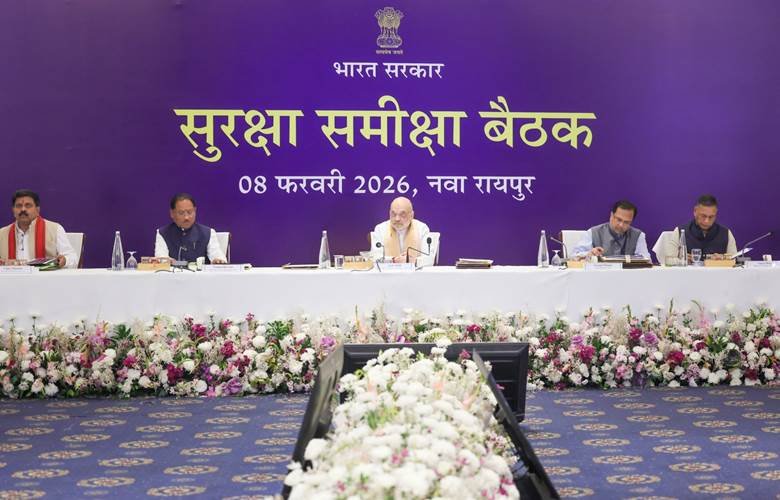
Union Home Minister and Minister of Cooperation Amit Shah on Saturday chaired a high-level security review meeting on Left Wing Extremism (LWE) in Raipur, Chhattisgarh, and expressed confidence that the menace of Naxalism will be completely eliminated from the country before March 31.
The meeting was attended by Chhattisgarh Chief Minister Vishnu Deo Sai, Deputy Chief Minister Vijay Sharma, senior officials from the Union Ministry of Home Affairs, heads of central armed police forces, intelligence agencies, and senior police officers from Chhattisgarh and neighbouring states including Telangana, Jharkhand, Odisha and Maharashtra.

Addressing the meeting, Shah said the combined security-centric strategy of the Centre and the Chhattisgarh government, supported by infrastructure development, targeted action against Naxal financial networks, and an effective surrender policy, has yielded positive results on the ground. He said Chhattisgarh, which was once a major stronghold of Naxal violence, has now emerged as a symbol of development under the double-engine government led by Prime Minister Narendra Modi.
The Home Minister said Naxalism has reached the verge of its end under the current government and reiterated the resolve to make the country completely Naxal-free before March 31. He said the long-running conflict has pushed several generations into poverty and illiteracy, and its elimination will open new opportunities for growth and inclusion in affected regions.

Shah emphasised the need for sustained and coordinated action, cautioning that the fight against Naxalism must not lose focus at this stage. He underlined the importance of seamless coordination among states and central agencies to ensure that remaining Naxal elements are not allowed to escape to neighbouring regions.
Highlighting the development dimension, the Home Minister said the youth of Chhattisgarh are making rapid strides in areas such as sports, forensic science and technical education, while continuing to preserve their cultural traditions. He noted that the state has registered notable progress on both security and development fronts.

Later, addressing a national conclave organised on the book ‘Chhattisgarh @ 25: Shifting the Lens’, published by Bharat Prakashan of the weekly magazine Organizer, the Home Minister said the problem of Naxalism is rooted in ideology rather than being merely a law-and-order or development issue. He said that when the Naxal movement began, there were many districts in the country that were more underdeveloped than Bastar, yet Maoist violence did not take hold there.
Shah said Maoist ideology promotes the belief that solutions can only be achieved through violence, which led to decades of disruption in development across large parts of central India. He said Bastar, rich in mineral resources, could have been among the most prosperous regions in the country if it had not suffered from Maoist violence for over four decades.
Highlighting recent progress, the Home Minister said that schools and hospitals have been rebuilt, roads and rail connectivity are expanding, and irrigation projects covering nearly seven lakh hectares are set to be approved. He rejected allegations of excessive use of force, stating that both the Centre and the state government want peace and are ready to welcome those who lay down arms and return to the mainstream.
Shah said that around 90 per cent of Naxal-affected areas have already been freed from violence and expressed confidence that the Maoist problem will be fully eradicated from the country before March 31, 2026, paving the way for sustained development and stability.
 ----------------------------------------------------------------------------------------------