

Water vapour heats atmosphere more than aerosols over Indo-Gangetic plain: Study
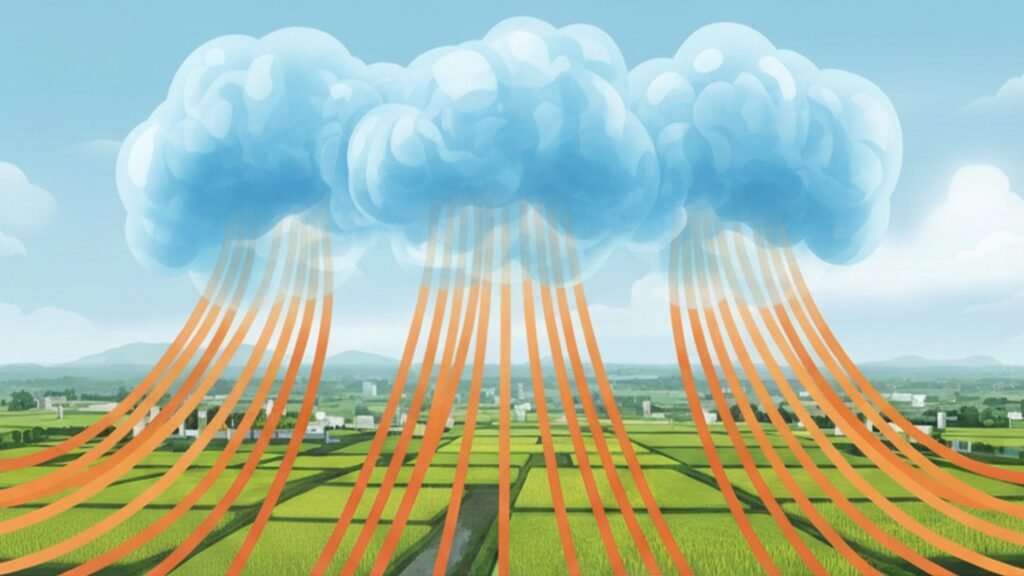
Water vapour plays a far greater role in heating the atmosphere than aerosols, particularly over the densely populated and pollution-prone Indo-Gangetic Plain (IGP), according to a new scientific study that underscores the need to jointly consider both components for accurate climate projections.
The research highlights that while aerosols and water vapour together shape the Earth’s radiation balance, water vapour has a stronger influence on atmospheric heating. Their interaction, however, significantly alters regional atmospheric dynamics and can have important implications for climate variability and the Indian summer monsoon.

The study was conducted by scientists from the Aryabhatta Research Institute of Observational Sciences (ARIES), Nainital, and the Indian Institute of Astrophysics (IIA), Bengaluru – both autonomous institutes under the Department of Science and Technology (DST) – in collaboration with researchers from the University of Western Macedonia, Greece, and Soka University, Japan.
Focusing on the Indo-Gangetic Plain, a global hotspot of aerosol loading with large spatial and seasonal variability, the researchers analysed the relationship between aerosol concentration and water vapour radiative effects (WVRE). The region’s complex atmospheric composition makes it particularly challenging to quantify the individual and combined impacts of aerosols and water vapour on climate.

Led by Dr Umesh Chandra Dumka of ARIES and Dr Shantikumar S. Ningombam of IIA, the team used observations from six AERONET (Aerosol Robotic Network) sites across the IGP. These ground-based measurements of aerosol properties were combined with radiative transfer simulations using the SBDART (Santa Barbara DISORT Atmospheric Radiative Transfer) model to assess how aerosols and water vapour influence the radiation budget.

The findings, published in the journal Atmospheric Research, show that water vapour’s radiative effects are strongly modulated by the presence of aerosols. The study found that WVRE is much more intense in relatively clean, aerosol-free atmospheres, both at the Earth’s surface and within the atmosphere. In contrast, when aerosol loading is high, the impact of water vapour becomes more pronounced at the top of the atmosphere.
Crucially, the researchers observed that water vapour heats the atmosphere far more efficiently than aerosols, highlighting its dominant role in influencing regional climate over the Indo-Gangetic Plains. The study also revealed that these effects depend strongly on solar position and atmospheric properties linked to aerosol absorption.
According to the scientists, the results underline the importance of accounting for the combined and interactive effects of aerosols and water vapour in climate models. Ignoring these interactions, they warn, could lead to uncertainties in assessing regional climate change, particularly in sensitive and highly populated regions such as the Indo-Gangetic Plain.
The study adds to growing evidence that a more integrated approach to atmospheric composition is essential for reliable climate assessments and future projections in India and beyond.
 ----------------------------------------------------------------------------------------------